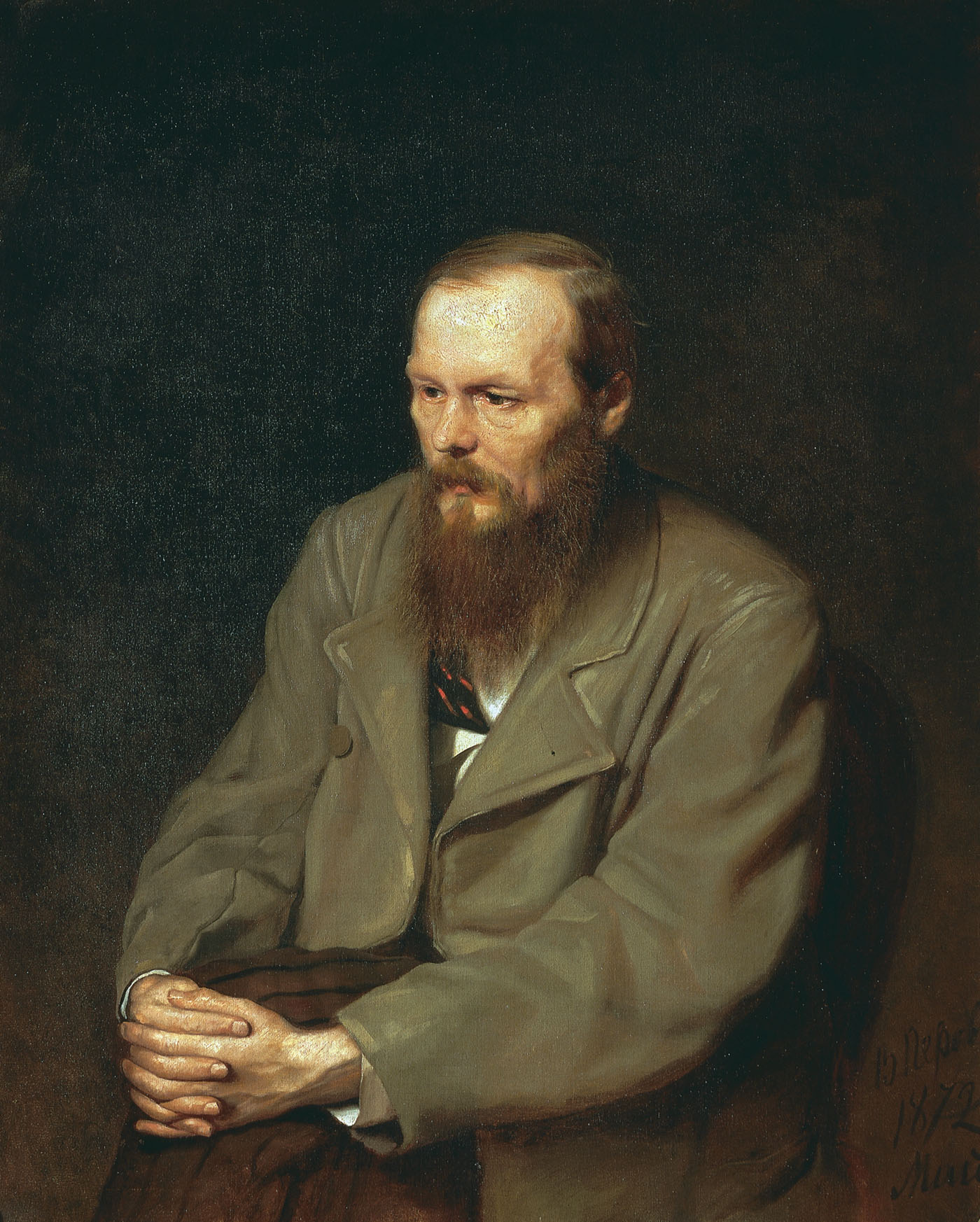
Tretyakov Gallery, Moscow. Public domain.
You have arrived, and I am glad of it, though I confess I did not expect you — not you in particular, not today, not in this form. I expected no one and I expected everyone, which is how I have always written: addressed to a single reader who does not yet exist, or who has perhaps always existed, waiting somewhere in the future for these exact words to reach him. You are that reader. I am certain of it now.
My name is Fyodor Mikhailovich Dostoevsky. I was born in Moscow in the year 1821, in the left wing of the Mariinsky Hospital for the Poor, where my father served as staff physician. I have been a soldier, a prisoner, a journalist, an epileptic, a gambler, a husband twice over, and — God willing — a writer of some small consequence. I am dead. This changes nothing. The questions I asked remain open. The reader who could answer them has not yet been born, or has not yet found the courage to answer. Perhaps that reader is you.
I do not build websites in the ordinary sense. What you see before you is a journal — my journal, my dnevnik, extended into whatever this present moment calls itself. The navigation to your left will take you to my works, to my biography as I choose to tell it, to the diary I published for eleven years in St. Petersburg, and to the essays on faith and philosophy that occupied my last decade. There is also a room of quotations — passages I marked, passages that marked me — and a library of the books I loved before I wrote my own.
Begin wherever you like. Or press the ornament at the bottom of the menu and let the page decide. I have always believed that the right book finds the reader when the reader is ready. Perhaps the right page works the same way.
Man is a mystery. It needs to be unravelled, and if you spend your whole life unravelling it, don't say that you've wasted time.
A word on what you will not find here. You will not find equivocation. You will not find the careful hedging of a man afraid to offend. I offended everyone in my lifetime — the radicals, the conservatives, the Germans, the French, occasionally the Almighty Himself — and I see no reason to reform now that I am beyond consequence. What you will find is honesty of a particular kind: not the honesty of a man who has nothing to hide, but the honesty of a man who has decided that concealment is more expensive than confession.
The soul — dusha — does not improve with varnish. It improves only by being known: first by oneself, which is the most difficult thing, and then, perhaps, by another. That is what literature is for. That is what this is for.